Wednesday, May 06, 2009

shallow are the ashes (of the children of men)

[Being the 7th installment of stuff I've been reading recently.]


Jonathan Strange & Mr. Norrell
Suzanna Clarke
(2006)

In the midst of the Napoleonic Wars, one Mr. Norrell has assembled the greatest library of magical texts in all of England, and with a showy display at York, revives the art of Practical Magic (as opposed to mere Theoretical Magic). Desperate to assist the war effort, he brings a Minister's young wife back from the dead with the assistance of a Faerie (the Man with the Thistle-Down Hair) in order to win favor with the Cabinet. He goes on to aid the British navy, conjuring up fleets of ships made from mist to blockade harbors.

It is around this time one Jonathan Strange makes Mr. Norrell's acquaintance and becomes his apprentice. Strange journeys to Spain where he operates as a field magician in the service of Wellington's army with much success.

However, when Strange returns his opinions of the practice of magic have changed to a more laboratorial approach, as opposed to Norrell's more bookish approach. Norrell also fiercely opposes any contact with Faeries, while Strange desparately wants their assistance, as the greatest English magician, The Raven King, was faerie educated.

The Man with the Thistle Down hair continues to abscond with English men and women, eventually driving Strange to Venice, and causing him to become captive in a tower of billowing darkness.

Jonathan Strange & Mr. Norrell is a weighty tome clocking in at the 800+ pages mark. It is written in a Jane Austen style, but I have to confess I've never actually finished any actual Jane Austen or the like, so I suppose in a way it’s an Austen-style but actually reads a little easier. On reflection, individual chapters are really brilliantly paced – a steady build to the next event, while the characters behave according to the norms of the period. Physical and social settings are era appropriate, sometimes delicious.

The real brilliance lies in the footnotes, which contain a detailed fictional bibliography of the History of English Magic. As the story unfolds, it becomes clear that Norrell and Strange are very (very) minor league English magicians, only doing their best to stand on the shoulders of giants. Especially the Raven King, a human raised by faeries who appeared in Northern England and acquired the same from the English king as a kingdom of his own (a claim he technically still holds – George III is only northern England's steward and caretaker), who takes on the dread proportions of nightmare as his history is revealed footnote by footnote.

The book is not for everyone, however, mainly due to the period-authentic pacing and writing style (easily slow and plodding, if one is impatient), and, as above, the main characters are rather mundane and not even supremely talented at the practice of magic.

Still, it’s a fresh piece of fantasy ("steampunk" even, of a sort), and one shouldn't just read Lieber and Moorcock forever (tho' one certainly could).

-d.d.

Saturday, April 04, 2009

your hands, my heart: what's so hard about that

Finally made it to a Warriors game last night. Pretty good turnout for a game late in a futile, ruined season; some culture shock, though. The crowd was undeniably Into It, with roused cheers never more than a half-decent play away. And the booting of evil-team failure was as robust as ever I've heard--when some cat missed two consecutive dunks, the rafters went a'-rumblin' for sure.*

And the crowd--to my relief but lack of surprise--passed my bush-league test, by cheering fairly well for the feat of the evening, a hesitation move perpetrated by Chris Paul, resulting in a truly wonderful cradling the ball stride goalward and gorgeous layin. In general, they seemed sure the Warriors would lose, getting ugly at 4-0 Hornets with around 9:45 left in the first. Late, when the game was tight, there would be total silence as Chris Paul plied his vile trade on the perimeter, and surging gouts of noise when West did brick off the glass, and the Warriors took to the offensive (tentatively and glitching).

Oakland boasts a crowd entirely ready to be won over. It's lovely, and a remarkable departure from the Portland crowd, richly blending entitlement and ignorance.

Unfortunately, my Portland-style commitment to heckling didn't go over for shit.** In the third, when my snack-bar excesses began to get on top of me, and as the Warriors gave up the bulk of their halftime lead, the furry hipster twits next to Abe and me were heard to enquire "Whoa. You ever been to a game with this guy before?" Whatever. Fuck you. White people wear sweaters to basketball games.

A few notes. When you show up and the home team has six guys in the layup line? Bodes ill for the evening's competitive balance, no? When the opening tip is botched, a fellow is entitled--indeed likely--to thoughts writhing toward the freeness of the tickets and the eleven dollarness of the pale ale. Early, it was Warriors 10, Chris Paul 10, David West 2.


At around 15-12, some cub with a vast, unmanageable head moved in front of me. With some despair, my eyes scampered around for a while.

I will not understand why the franchise's banner is relegated to the side of the arena, essentially invisible. True, it's 34 years old, but that seems a poor reason to quit wallowing in it.

In the first half, the Warriors' unvaunted offensive sets seemed to me to bespeak a philosophy running something like "if we don't run any plays, they can't defend them!". This is particularly amusing given the lengthy, po'-faced coverage in local media on the topic of Nellie's revamped offense. (Halfway thru the season, he realized he didn't have any point guards, and if you can't run a real offense, you might as well have one guy trying to break down his man off the dribble while four guys camp on the 3-point line, waiting for their defender to do something stupid. PROTIP: their defender will eventually do something stupid.)

Sobersided analysis aside, if you've got a backcourt of Crawford and Ellis, you might actually as well just let them freelance a lot and spend your evenings hollering "pass" every couple possessions. Beats actually trying to design sets cohering around Stephen Jackson's (functional, Raphaelite***) insanity.

Eventually I remembered the atrocities perpetrated by David West--second in a noble lineage of History's Greatest Monsters at the four from Xavier--vis-a-vis my crippled foray into fantasy basketball this season. My thoughts turned away from my second trip to the bar (not the snack bar) and turned towards a fraught yearn that somehow, some way, my words could reach the man and ruin his life.

Alas.

The evening bloomed into a middling example of late-season meaning. Hornets exposed as a pathetic mockery of a contender, with CP3 a selfish gunner incapable of involving himself with any team member. Warriors demonstrating again such a thorough commitment to pointless, head-down freelancing that they must actually be being coached into it. Warriors fans intense, tense and grateful.

Fat, fat, happy, drunk.


*After the second dunk-butchery, CP3 ran down the board and took it to the hole himself, unopposed breakaway. The cat who'd missed the two dunks was right next to him, wide open obviously and necessarily. This savage violation of every rule of point guard play led me to bellow "Paul, you're in the hall of fame of bush-league hacks!" This was recieved like the introduction of pornography to sunday dinner.+

+I should note that I adored (major swathes of) Andre Miller's Nugs tenure, which featured nigh-endless callings of his own number. My rule of thumb was that if he had eight assists, he'd probably only actually passed twelve times. The difference is that nobody worth listening to ever said Andre Miller was a good point guard.

**At a Lakers game some years back, DDT at one point reduced me nearly to tears by hollering "Tonight we raze the peninsular villages!".

***The other one, the Ninja Turtle.

Heckling is, I think, an exponent of Portland's peculiarly thorough involvement with localism (equally describable as Portland's compleat obsession with its piddly, second-rate self). Since everybody on stage is literally your neighbor and peer, there's no barrier to abuse, no separation between performer and audience.++

Now, Oakland is at least partially infected by the Bay virus of self-importance and utter absorbtion into self. The difference is that Portland at least knows it's no first-rank city; the Bay genuinely believes it's a cultural heavy hitter, on a par with New York, London, Paris. Which blends the annoyances of the second rate with the frustrating asininity of the delusionally self-important.

But, since Oakland thinks it's great, and thinks its products matter in the grand scheme of things+++, some jagoff in a black sweater hurling abuse at a putative MVP candidate is likely to be a nutjob worth ignoring, rather than one voice amongst a panoply of same, perhaps an initiator of conversations and a positer of position.

And yes, I do get that heckling is a twerpy manifestation of smug hipster claims to importance, wherein the act of judgment is held to be at least equivalent to any act of creation.

++This, by the way, explains why a heavy metal band like Poison Idea is such a conundrum for categorizers of music. In formal terms, they are undeniably purveyors of moderately competent heavy metal. However, there's something not easily definable about them that queers and clouds the issue something fucking fierce. Best way to explain it runs: it's metal played by punks; they're from Portland.

+++With the exception of Neurosis, they don't, they really really don't.

Friday, April 03, 2009

write a new tune

I don't that often do this, but this review actually made me laugh out loud. More than a single time.

In other news, I'm broke as a joke, working 50-hour weeks to try to make up for it, and desperately craving the following:
new hat (black, summer weight)
new shoes (two pairs Starburys, prolly)
MadWorld
House of the Dead: Overkill
Grand Theft Auto DS (I keep trying to remind myself that it's a driving game, and I basically can't stand driving games)
new front wheel for my commuter bike
new brake cable for my fun bike
new bike bag (I loathe my backpack)
new pants (bike wreck shredded my work pants, and nothing else I have is entirely appropriate for an office environment)
DVD player (so I can enjoy my new Venture Brothers Season 3 dvd)

Oh yeah: I'm going to a Warriors game tonight. So I got that goin' for me.

Saturday, March 21, 2009

I'm inclined to go finish high school to make her notice that I'm around

As DDT muses on Astro Boy and upon Akira versus Blade Runner, I read somebody finally telling my truth about Watchmen: great mostly because historically important, not so much because of its actual success in/of execution.

For ten years or so, I've been wondering if maybe I loved it so much b/c I was so embedded in the superhero genre. What would somebody think of Watchmen--or the Dark Knight stuff--if they HADN'T grown into a Marvel Zombie as a reaction against their father's love of Superman comics? My contention is that the primary genius of these works is that they reimagine certain genre conventions; as such, they may be smarter and more interesting than straight works in/of that genre, but they have less energy and actual invention (as opposed to reaction) than straight genre pieces.+

Or maybe I'm just suffering from Watchmen fatigue, b/c I read it at like 14, and read and reread it in my obsessive way(s) and have been hearing everybody ELSE babble on about it for a year or so now. (See also my recent suspicion that Moore, for all his smarts and skills, doesn't have much to say.)

At some point, I should go back to my Levi-Strauss, bone up on my structural study of myth, and show that Watchmen is the most structually* perfect** piece of mass-market art ever made, probably.***


(Image stolen from http://www.goulfinger.com/hhcrematia.htm.)

I don't know why I never thought to google her before. I literally grew up on Crematia Mortem, a KC version of Elvira, with more wit and smarts. Late-night horror flickering on a too-small tv, all the ads tiny local businesses, up late on jellybeans and the sheer adrenalized pleasure of being up late for its own sake. Nothing like this exists anymore, probably. There have, naturally, been greater losses, but some cursory googling and clicking I find myself heartened by the reasonable amount of information out there. Gone and lost, yes, of course, but at least not forgotten.

Quick reviews:
Phoenix Wright (DS): Pretty good. Point-and-click "adventure" game, basically just a reading game. Like playing an episode of Perry Mason. Nothing in the world wrong with playing an episode of Perry Mason.++ I have a minor quibble that all the stores are lighthearted stories about murders. It's a wierd disconnect. I'm impressed by how quickly and thoroughly the makers make me care about Phoenix's (quickly murdered) mentor. Not sure how they do that, exactly; might be the titties.


(Image stolen from http://www.ace-attorney.net/content/images/artworks/gs1/mia.jpg.)

Jake Hunter (DS): Pretty good. Even more of a reading game than Phoenix Wright--actually basically a visual novel. And not a very good novel at that. Got HORRIBLE reviews and I can't really tell why. Not a great value for money, I guess, but for 20 wing-wangs, I really am not prepared to bitch too much.

Touch Detective (DS): Lighthearted point-and-click adventure game; much more of pixel-hunt and DESPERATELY ANNOYING puzzle play than reading play. I love the visuals, loathe the puzzles, am basically enthusiastic about the whimsey. There's a LOT of whimsey. Typical Atlus game--wonderful style, but substance that's undercut by its insistence on difficulty.

Hotel Dusk (DS): If you play only one point-and-click adventure game with a HEAVY reading component, give Phoenix Wright a skip and try this one. Couple really wonderful puzzles, well-honed noir text, and an exceptional sense of tone, with resignation nicely leavened by humor.

Final Fantasy: Crystal Chronicles (GCN). Finally got my GameCube back, and dicked around with this for a few nights. It really is absolutely gorgeous and fairly dull with only one player. Maybe I think it's dull because I really suck at action RPGs. But this is just a less hip version of the equally beautiful, and equally dull, Phantasy Star Online. I have a minor plan to browbeat DDT into buying a DS so he and I can annihilate space and play the new DS version of Phantasy Star Online, but I don't think this will ever happen... If it DID happen, then my penchant for creating support characters maybe wouldn't get me killed all the fucking time.

Oh, who am I kidding? DDT would pick like a ranged magic user or something, I'd pick a ranged combat person, and we'd get squashed constantly b/c we refused to just play a fucking tank.

Alien Hominid (GCN): ABSURDLY hard run-&-gun shooter. One-hit kills, stiff controls, good but tension-enhancing music. I'm playing it on medium, and really the only version of the game I can play at all is "how far can I get before I have to continue". Brutal and not actually very fun (similar to PN.03, actually) but weirdly suffused with genuine joy. It's clear that the art--all of the art--was loved as it was being made, and that carries me through pretty far. Well, as I mentioned, I don't actually get far, but it keeps me coming back to try to perfect and polish my performance of the tiny fragment of the game I'll ever actually get to see.

Viewtiful Joe (GCN). All the good stuff about Alien Hominid, but substantially more accessible, without being in any sense easy. I will likely never finish this game--it's one of the first ones that I picked up when I picked up my GCN for the second time--but playing through the first few bits has been one of the most reliable pleasures the medium has ever offered me.

Onechanbara: Zombie Bikini Slayers (Wii). Because my main problem with Zombie Revenge really was that all the player characters and bosses weren't hot half-naked chicks. There are some wonderful things about Japan, and this infinitely stupid game is one of them. Plus, it demonstrates beyond any disputation that No More Heroes got a hell of a lot right about its combat, b/c all the criticisms more or less unfairly levied against it are actually accurate when it comes to Onechanbara. But come on. You're playing a game with "Zombie Bikini Slayers" in the title. The fuck did you expect?

+The pirate stuff, while still striking me as basically pointless and baffling in its inclusion, is a straight exercise in genre tribute. As such, it's energetic and fun in a way that nothing else in Watchmen is, really. Except maybe for the romance comic tribute denoument, when Dan and Laurie get to gad about in exciting new wigs...which also, of course, is another genre exercise.
*In the sense of structure as known by structuralists. This word probably should have been structuralist-ally.
**In the sense of "complete", not in the sense of "good". It's finished off exactly the way it was supposed to be, for better or worse.
***Don't laugh, but Star Trek: Nemesis is also structurally perfect. Misbegotten and dull, but perfect.
++All punks love Perry Mason. I don't know why.

Tuesday, March 17, 2009

Streets of Astroboy

Turns out the world if full of Astroboy graffitti.

Astroboy!
image:Narisa

Shooting for the Stars
image:jesper11

Astro Boy
image:wadem

astroboy media
image:wednesday Mc Shiver

Astroboy! astroboy by UfO
image:dier madrid; image:UfO

Astroboy
image:rotokirby

Astroboy IMG_4789
image:Rubira; image:nettsu

castro boy Astro-streetart
image: sensemaybenumbed; image:The Daemon

Astroboy
image:ScottD_Arch

Astroboy x subversion
image:fooishbar

It goes without saying, the last one's pretty awesome.

-d.d.

Thursday, February 19, 2009

The Many Faces of... MITCHELL!!

Mitchell!
image:pupkin

Mitchell!
image:pupkin

Mitchell!
image:pupkin

Mitchell!
image:pupkin

Mitchell!
image:pupkin

I really need to watch this episode again. Always get seduced by some other, newer re-released episode or set whenever I'm about to take the plunge.

Fat says this episode always makes him cry (its Joel's last), the big ol' softie.
-d.d.

Sunday, February 15, 2009

a cheap paperback life

AKA:

locusts, rain and the cosmic thwart


I've lived in Santa Destroy for coming up on 10 months now. I'm preparing to move for the second time. It's been raining for days.

I live pretty close to the bone here: I wasn't working those first four months, the surround be 'spensive* and I don't exactly have the best job ever had by dog, man or boy. One of the biggest structure hits I've taken involves my DVD player. The second I got it uncrated, I discovered that the remote had become one with the infinite. Its functionality is thus down to play/pause, stop, and open/close.**

It's been raining for days. A specific kind of rain unknown, basically, in Portland: hard, loud, spatters and pools. Melancholy and drunk in the afternoon, trying to pack without any boxes to speak of, I throw movies on in the background. The rain and the lack and the muted emotional palette put me in the mind of Evangelion, never afraid to give you a half-minute of raindrops pounding slick city streets or the desolate, isolated drone of locusts.

Alas, my copy defaults to the dubbed version, and I can't change that. I made it all the way until Shinji opened his mouth, but I absolutely can't tolerate the wrong voices this time around. All I want is my friends in the background, half-distracting me from the tedium of cramming my preposterous piles of prized possessions into more mobile configurations. Cold blusters outside, I'm blowing spit bubbles, strangely drained, out of both beer and hope. 10 months. Ready for that new life any day now...

Couple weeks ago, I picked up Super Dodgeball Brawlers for my DS. Like so many of the modern-era Nintendo products I've picked up, it's optimized for multiplayer. Like half the world at the moment, "optimized for multiplayer" actually means "pig-fucking useless in single player". Took maybe two couple-hour sessions to complete,

Not terrible, though: I'm a sucker for the Kunio steez, and the game plays at an excellent pace, both quick and heavy. There's the predictable amount of micromanaging possible, with mostly pointless items and accessories, and I have to admit that I had ridiculous fun making a custom squad.


That's Collision, me, DDT and Silken Thomas there. Good stuff. Thoroughly mediocre experience, but there's very much a time and a place for mediocre experiences. Here in Santa Destroy, in the rain.

It's been raining for days.


*Makes me pensive.
**I've tried two separate low-rent universal remotes. Neither supports my mighty Coby model.

Here come the dreams that are split at the seams


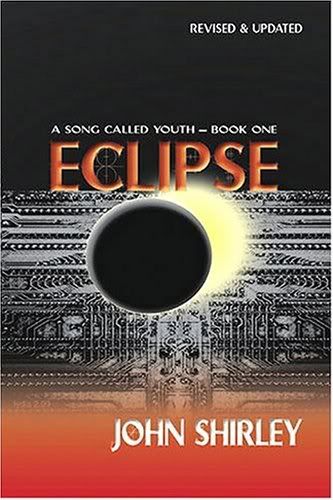
Eclipse
John Shirley
(1985)

In Eclipse, many of my favorite things about John Shirley dovetail together, creating a sort of Janus-faced monstrous representation of my tastes in writing, culture, and politics. Eclipse portrays the near-future unfolding of a neo-fascist supra-national empire in the wake of a non-nuclear World War III. Europe is in ruins, but armistice has been achieved (or at least stalemate), and to bring stability to the ruins of France a third-party security megacorporation called Second Alliance (SA) is contracted to begin the rebuilding. Of course, it turns out the SA is part of a complex and broad-sweeping neo-fascist plot of world domination, headed by an American evangelical Christian.

In opposition to this plot is the New Resistance ("NR"), headed by an ex-Mossad higher-up named Steinfeld and financed by an American billionaire who is also SA's chief economic rival. The book mainly traces the paths of several individuals who become part of the NR for a myriad of reasons, and this volume also features a parallel storyline involving the SA takeover of FirStep, the space colony orbiting the earth.

As great as Shirley is at sketching the insidiousness of this neo-fascist plot (there's a great sequence where these two neo-nazis from Idaho show up at the SA compound, dressed out in full Third Reich regalia, and one of the upper-level SA execs summarily shoots them in the woods while explaining to them that the whole Nazi-model is both stupid and not ambitious enough, and of the effect of the war (or crisis, generally, I suppose) on the modern world (a great bit by one character, "Hard Eyes," about how before the war he didn't care about much, just when the next new digital music player was coming out – the pointless but comforting rhythms of consumerism), the heart and soul of this book is Rick Rickenharp.

Rickenharp is a washed-up rock star of the 1970s-1980s mould: long hair, blue jeans, leather jackets. But his preferred music form fell out of style long ago (except for a short retro craze), and the book finds him playing a gig in FreeZone, a floating city somewhere near the Canary Islands. Rickenharp and the band realize they're playing their last show together, and then Rickenharp runs off with a younger blue-haired girl and her friends to join the NR. Later, Rickenharp confesses of feeling "awake" or "alive" for the first time in a long time, if not ever. The book's must-be-read-to-be-believed conclusion revolves around Rick's last performance.


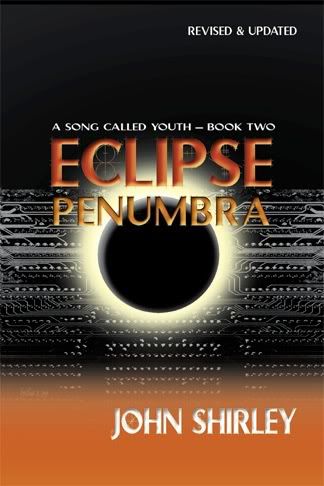
Eclipse Prenumbra
John Shirley
(1988)

Eclipse Corona
John Shirley
(1990)

Unfortunately, I cannot recommend the second and third volumes of this series as strongly as the first. As mentioned elsewhere1, Shirley has integrated several of his short stories into the narrative of both these novels, especially Eclipse Prenumbra. Still, Prenumbra includes more of the FirStep storyline, which is actually quite compelling, and I almost wish all of that arch could be collected in one volume. Shirley also forays into pretty straight combat narrative for brief spells. And although I was disappointed to discover he had conscripted previous short stories into the Eclipse narrative, Shirley really did a superb job stitching those stories and characters together into a larger narrative – for the most part you are only dimly aware that the narrative has gone a bit tangential.

In Corona three things stand out: a fantastic sequence about an SA diehard who comes up to the brink of the SA's true purpose (genocide) and finds that he cannot follow through. Secondly, a compelling tale of an undesirable confined to an SA version of the Warsaw Ghetto, and the unfortunate circumstances of his escape. And lastly, of course, the NR Strikes Back to bring the sequence to its end.

-d.d.

1 See my notes on Shirley's short-story collection Heatseeker.

Saturday, February 07, 2009

never a simple chimaera

It has been a while, and then a while. In the doldrums, becalmed by a season in which my local Warriors are tepid whilst bland. My ancient ways of loyalty to Denver have been sorely strained by their unintriguing competence; I retreat to my tent with a stack of novels.*

Through the summer, I fattened myself on the works of Steve Gerber, as Collision's interest spurted into obsession. Mostly I found Marvel Essentials collections--volumes containing 20-some issues, & the only way to read comics in these revolting times. In order:

  • Howard the Duck
  • Man-Thing
  • Man-Thing 2
  • Hard Times: 50 to Life
  • Omega the Unknown
  • Howard the Duck MAX
  • Dr Fate: Countdown to Mystery

All this in something like 6 or 7 weeks.

Gerber is the echt humanist--angry, frustrated, despairing, depressed, energetic. I like him less than Collision does, b/c I'm nearly as interested in things as I am in people. (Also, unlike Collision, I haven't that much use for those works mainly about comics: HtD, Omega the Unknown... For me, his greater achievements were not primarily critical: Dr Fate, Hard Times, HtD MAX, and above all, Man-Thing.)

Still, though nothing here topples V for Vendetta from Fat's Throne, I do now suspect that Moore, for all his mammoth achievements and indisputable genius...doesn't actually have very much to say. Or, anyway, anything much to say about things other than books. Gerber at his best is at least talking about life, the intercourse of those sad, confused apes & the tragedies, hijinx, frequent lived nightmares & occasional connections they variously chase and endure, like so many mad, desperate pinballs.

I have since summer sworn off buying comics for the remainder of 2009--a protest against bad products delivered thru an absolutely asinine business model. My swan song (of myself) was American Flagg.

This monumental little triumph displaced from Fat's Throne of recommendations the Dark Knight. Turns out, a couple years before Miller, Chaykin had done everything Miller would do, only more inventively & much, much funnier. Also, his characters are closer to actually, interestingly fucked up (impotent, drunken, violent in sex & friendship) than Miller's cartoons of fucked up (grimjawed revengey solitude).

Stunning piece of work, and an essential experience whether or not comics (or cyberpunk) is of interest to you.**

I also had a long engagement with Michael Moorcock. I'm not quite ready to blurb on this, however I note for the moment that one conquering facet is his combination of a set of explicit politics with a set of aesthetics, this combination forming what I'd call the ethic of these books.

Moody bastard heroes, strong & mostly aloof, generally looking out into lives suffused with doom like ashes freshly on a tongue; yet arguing to & for truth, fumbling towards good & the good; trying.

Also, this cover sells itself.


*There is going to be a notion about how nobody is paying attention to the Nuggets, so lookout, West! This will inflate right quick into a widespread belief--and a positive raft of posts--that nobody is talking about the Nuggets, thus the dark horse in the spot light.

**One big success for Miller, though, was the Spirit. Here, he mangaged to combine Eisner's slapstick (schlubs, schmucks, & schlemiels) with Eisner & Miller's noir (dolls, molls, thugs, fists bricks & breasts). Somehow, it worked marvellously, this blending of two quite distinct refractions of life.

Friday, February 06, 2009

Hanging at street lamps looking for action


Mindplayers
Pat Cadigan
(1987)

I was pretty stoked when I found this paperback at the Goodwill for a buck, since I'd heard about Cadigan as a kind of o.g. cyberpunk, and I had recently become a bit self-aware of the lack of female authors in my library. The premise is certainly interesting: when technology can interact with the human brain, then a multitude of pleasures will be generated using that technology, and, as with all pleasures, some will cross over in the realm of vice. And were there is vice, you essentially get… social workers. Our protag is one of these psych-social workers, who uses tech to actually get inside her patients' heads. Includes a fave insight from a novel ever: that our delusions are precious to us. Personally I found it difficult to read. Cadigan's prose doesn't work that well for me, and the afterword reveals it was originally a series of short stories, which might explain some difficulties I had keeping my attention on the plot.


When Gravity Fails
George Alec Effinger
(1986)

The first of Effinger's Marid Audran novels, set in the Budayeen pleasure district of a fictitious desert Arabic city.1 In a future where almost all enjoy the varied benefits of "chipped-in" neuro-enhancements2, Marid Audran opts instead for wily street-smarts and a steady diet of pills and alcohol. Marid is a fixer, always hoping to mediate or facilitate his next few months rent, and is quite good at it, in a way. Then Friedlander Bey, the city's own criminal godfather, as it were, taps him to look into a murder. Along the way Marid must become the things he most prided himself for not being, though, in the process, one has to question whether he was much at all in the first place. The Budayeen, it turns out, is almost exclusively the territory of sex-changes and the heavily physically modified; various ex-pats and the faux-couture. No one really amounts to much, however, and most are merely the pawns of men like Bey. I regularly regret the untimely passing of Effinger in 2002.


Islands in the Net
Bruce Sterling
(1988)

Previous to this book3, I think the only work by Sterling I had read was the anthology Mirror Shades, A Good Old Fashioned Future, Schismatrix Plus, and his Gibson collaborative effort, The Difference Engine.4 In short, he was mainly an editor on Mirror Shades, Old Fashioned is easy to like, being both short stories and a particular good collection of the same, and Schismatrix Plus is a cyberpunkian-spin on Stapledon-flavored space opera, so none of these are particular indicative of Sterling Just Being Sterling. Islands in the Net, however, gives you a strong sense of why he was the Cyberpunks' guru-in-residence. At face, this is a story about a married mother who is part of a near-future national-level co-op business, who is selected to represent her company in Granada. Events with potential world-shaking consequences follow, taking her on the patented Sterling Candid-esque journey 'round the world: Galveston, Texas – Granada – Singapore – Africa. At each stop we are given a sketch of some new model of the world. Models, which, in some standard "futuristic" sci-fi story, would be the (paternalistic) "hero" of the story: hi-tech super-soldier rebels in Granada, a tiny city-state with the tech and the will to power in Singapore, or bigger-than-life warrior-poets playing Laurence of Arabia on dune buggies in the Sahara. But in each case these models lose out our maternal protag. A sobering and thoughtful (and hopeful) look at the future.

-d.d.


1 This city, but specifically the Budayeen, is heavily modeled on New Orleans, Effinger's adopted home. An odd pairing, to be sure – a barely concealed Bourbon Street mapped onto a well-researched Islamic future.
2 But the 'Net is oddly (and kind of refreshingly) absent, or at least not mentioned.
3This book along with When Gravity Fails consist of Exhibits A and B in cover art my wife makes fun of me for. Gravity Fails' rendition of Audran (we can suppose) is a bit on the effete side, and Islands features cleavage. Obviously, there can be nothing serious to contemplate in these books, to judge by the covers.
4 I have come to grips with my feelings that the Difference Engine is not a very good novel. Mind you, it's actually much better than a ton of stuff out there, and is actually pretty marvelously detailed, but I don’t think it plays particularly well to Gibson or Sterling's strengths. Sadly, I think I've actually read this book THREE times, which probably makes it Exhibit A in the criminality that can result from re-reading books in your personal collection.