Frequent site contributor Bob Macajew, currently in SoCal exile, texed me the other night:
Was there a racial component to this GSW/Indy trade?
My response:
It's the third-most interesting thing to talk about in this trade, after Mullin ditching two massive investments of two years ago, then the way lil' Dun and Murphy look like perfect Nellieball guys, but (apparently) totally aren't. But, yeah, it's probably tough to sell Mike and Troy to fans in Oakland.
Troy Murphy is one of my favorite NBA moments, oddly. I knew his name was "Troy Murphy", and I knew he'd gone to Notre Dame, but I was still surprised to find out that he was white. I uh. I blame my paint problem(s).
In other news, DDT and I had an intensely long-ranging and wide-running NBA meeting last night. Among (many) other points, he suggested that the Rise of Gilbert Arenas 2006-7 is essentially AI01 redux. There are many things to be said about this putative parallel and its possible implications, and I have urged him (twice now, counting this) to say some of them. I want to point out merely that:
1.
It hurts a very little bit for me to watch this guy go mainstream. Taken from the Wizznutzz and FreeDarko, filtered through Deadspin, and then appropriated by ESPN, adulation for this guy is no longer a lovely in-joke.
2.
This hurt is ameliorated hugely by the fact that his new nickname, as ratified by ESPN and whatever, "Agent Zero", is 'way lamer than the first one I ever read, the NYCentric "the World's Most Famous Arenas". Now that was a nickname!

Wednesday, January 31, 2007

Thursday, January 25, 2007
The Incredible P.W.E.I. vs. The End of Evangelion.
I picked up Pop Will Eat Itself's singles for Karmadrome & Dance of the Mad off Amazon. Turns out Karmadrome has the song "PWEI-zation" on it, which I had completely forgetten existed.

I've heard it before, of course. Back then the only PWEI I had possession of (dark times, those) was the 16 Flavors of Hell compilation disc (I think I had the Looks or the Lifestyle, too). I lost that disc (still don't know what happened to it), & when I subsequently filled out the rest of my collection, forgot all about "PWEI-zation."
So you can imagine, perhaps, the tingly surprise at re-hearing the song for the first time, in, say, 7-8 years.
Naturally, 3 or 4 hours of editing subsequently results in "The Incredible PWEI vs. The End of Evangelion."
-d.d.

I've heard it before, of course. Back then the only PWEI I had possession of (dark times, those) was the 16 Flavors of Hell compilation disc (I think I had the Looks or the Lifestyle, too). I lost that disc (still don't know what happened to it), & when I subsequently filled out the rest of my collection, forgot all about "PWEI-zation."
So you can imagine, perhaps, the tingly surprise at re-hearing the song for the first time, in, say, 7-8 years.
Naturally, 3 or 4 hours of editing subsequently results in "The Incredible PWEI vs. The End of Evangelion."
-d.d.
Wednesday, January 17, 2007
Gilbert Arenas is a Giant Red Robot.

Not quite sure how or why "Gilbert Arenas is to the NBA what Neon Genesis Evangelion is to japanimation" swam out of the backburner regions of my brain, but it resulted in the above image.1 If anything its the result of the same process which made imposing Astro Boy's head on the Larry O'Brien trophy a perfectly natural thing to do.2
The following clip from the movie End of Evangelion seems relevant & somewhat explanatory. Tossing battleships at tank columns, getting hit in the face by ballistic missiles, bragging about your 12,000 plates of fortified armor & how there's no way you can lose ("not to you bastards!"), & casually spin-kicking VTOL attack aircraft feels like Arenas' modus operandi.
Whether Arenas' has a little red-headed girl speaking Japanese inside his head is up for debate.
-d.d.
1 If I were to expand the Gilbert=Evangelion hypothesis into a generalized theory equating certain NBA players to japanimation (stylistically & historically), then I would venture that Jordan was/is Akira, which would make Kobe Ghost in the Shell.
2 See "Reviewieran Iconography 101," September 7, 2006.
Monday, January 08, 2007
Pre-Reviewieran Society.
Mulling it over, I now realize that the goal of this rather muddled post was to construct a historiography of how it came to pass that NBA fandom has evolved a new species of fan typified, for lack of better defined characteristics, as "anti-fantasy league." The central tenet of this fan-type is that he noticeably unimpressed by stats & W-L records. Rather, his favorite players &/or teams are dictated not by point scored or rebounds snagged (or games back or ahead), but because he/she feels that given player or team somehow says something about who the fan is as a person.
Although this thesis makes PERFECT sense to me, its difficult for people not really interested in the NBA in the 1st place to wrap thier brains around this idea. Its equally difficult for the larger contigent of fans, the very "fantasy league" fans themselves, to grasp what the fuck thier cousins are talking about most of the time. For them it is simply a matter of "Nate Robinson is awesome" & "Carmelo is a bitch." This is usually the result of limited delving into available NBA media resources. These same fans are prone to blanket statements, stated as pure fact, such as "the team w/ the highest chance of getting the number 1 draft pick NEVER gets the number 1 draft pick," even though this is patently untrue: see Cleveland, LeBron James, and Orlando, Dwight Howard.1
In the original muddled piece, I cited Simmons & Freedarko as steps of this evolution. Fat (correctly) cided me for forgetting to also throw Chauncey Billups in there & really, honestly, criminally neglecting to add Lang Whitaker's "Daily Links" to the equation. Indeed, every day at lunch from roughly 2000 to probably 2004 my NBA reading was limited to whatever bones ESPN was throwing me & the Daily Links. Then, as I recall, they got a good blogger over the Oregonian's Blazer's page, who ended up pointing me to Truehoop. A co-worker into McSweeneys sent me a link to a Wizznutz article McSweeney's had reposted. Truehoop led me to Freedarko. The Daily Links & Sportsguy & ESPN became rather dry & useless to me. But wayyyyy back at the beginning there, there was the early pupa of Reviewiera, perhaps. And its name was Eighty-Two.
Eighty-Two was a real, honest-to-good, printed-on-fucking-PAPER NBA 'zine I started in the summer of '01. I confess, at the time I was regular junkie at the Slamonline bulletin boards (ugh), nearly getting myself in trouble a few times at work for spending too much time there when I was supposed to be shuffling paper. At some point I got this idea to have other board-posters write little articles & email them to me, & I would format them & add purty pictures and then mail the final result to the contributors plus anyone reading the threads who was interested. We would then CONQUER THE WORLD w/ the FIRES of our NBA REVOLUTION...
Since it was the summe of '01 the first issue, of course, had Iverson on the cover.

Always liked those action line thingys radiating out from behind his head.
There were ten articles. None of them were very good, or even any good, to be honest. A lot of Iverson love. Some bold predictions & daydreams about the next season. Still, it was fun to put together. For the follow-up a season preview issue was decided on.

Larry Johnson quiety retired due to his bad back right before the start of the '01-'02 season, so he got the cover. The article count balloned to 22, although only 4 teams combined from the Midwest & Central Divisions (Dallas, Minnesota, Toronto, & Milwaukie) were previewed. Included in the 52 pages were ruminations on the return of zone defense, MJ in a Wizard's uniform, & a rather surreal article by yours truly about Harold Miner most consisting of the google translation of a german bio on Miner, which yielded gems like the following:

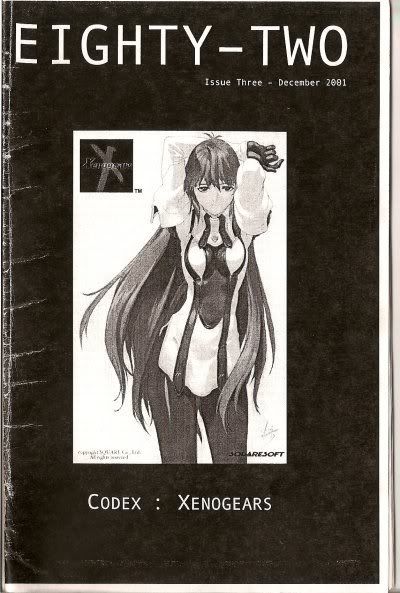
The FFT booklet was just 18 pages long. A walk-thru & some basic info on the various jobs of the game. But I think you might see where this is going. The portal had been crossed, & the world of the NBA invaded by stranger denizens. Issue 3 of Eighty-Two was thus the mammoth 46 page Codex:Xenogears issue, of which one copy exists, of which I have misplaced twice only to rediscover later. This is really was (and is) an encyclopedic resource for playing the Playstation RPG Xenogears. Perhaps the less said about this the better, tho' obviously I wasted many a lunch break putting it together.

I think by this time the actual reality of doing another collaborative NBA zine issue had collapsed due to boredom, laziness, & whatever unimportant reasons which seems important at the time. But I was still digging getting a hold of this formating of booklets thing, so Issue Four had the text from three William Gibson articles & an article about & an interview w/ Jim Thirlwell.

I like the "Today's Specials" menu motif on that cover.
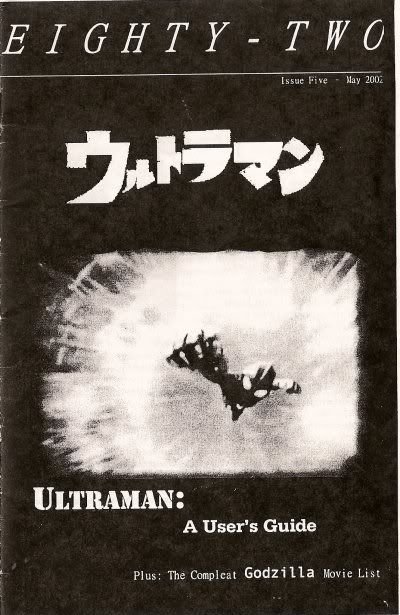
Issue Five was probably the shittiest. Ultraman: A User's Guide. I was into kaiju stuff for a bit there. I tossed my online research into booklet form. 16 pages.

Issue Six in September of 2002 was better, & the last. Game hints for Frontmission3 & Legend of Mana. The text from David Foster Wallace's "f/x porn" article. Some filler in the form of additional Ultraman information. 56 pages.
Of course, the real breakthrough was that the title got changed to "Tinzeroes." As I wrote (to myself, I guess), in the Note from the Editor:

So there you have the pre-Reviewieran symbiosis of NBA & other stuff that I like: namely cyberpunk fiction, video games, Japanese cinema, & the music of JG Thirlwell.
-d.d.
1 Glancing through year-by-year standings & draft order, I was very quickly struck by how often, by sheer eternal shittiness, the Clippers were always at the top in terms of lottery balls, yet for the life of them could not draw a fucking No. 1 pick overall. Ditto for the Vancouver Grizzlies, who had lottery ball position in '96 (Iverson) AND '97 (Duncan), as well as '99 (Brand). The Grizzlies consolation prizes were Shareef Abdur-Rahim, Antonio Daniels, & Steve Francis, who memorably forced a trade to Houston (in exchange for Othella Harrington, Antoine Carr, Brent Price, Michael Dickerson & a 1st round selection).
Although this thesis makes PERFECT sense to me, its difficult for people not really interested in the NBA in the 1st place to wrap thier brains around this idea. Its equally difficult for the larger contigent of fans, the very "fantasy league" fans themselves, to grasp what the fuck thier cousins are talking about most of the time. For them it is simply a matter of "Nate Robinson is awesome" & "Carmelo is a bitch." This is usually the result of limited delving into available NBA media resources. These same fans are prone to blanket statements, stated as pure fact, such as "the team w/ the highest chance of getting the number 1 draft pick NEVER gets the number 1 draft pick," even though this is patently untrue: see Cleveland, LeBron James, and Orlando, Dwight Howard.1
In the original muddled piece, I cited Simmons & Freedarko as steps of this evolution. Fat (correctly) cided me for forgetting to also throw Chauncey Billups in there & really, honestly, criminally neglecting to add Lang Whitaker's "Daily Links" to the equation. Indeed, every day at lunch from roughly 2000 to probably 2004 my NBA reading was limited to whatever bones ESPN was throwing me & the Daily Links. Then, as I recall, they got a good blogger over the Oregonian's Blazer's page, who ended up pointing me to Truehoop. A co-worker into McSweeneys sent me a link to a Wizznutz article McSweeney's had reposted. Truehoop led me to Freedarko. The Daily Links & Sportsguy & ESPN became rather dry & useless to me. But wayyyyy back at the beginning there, there was the early pupa of Reviewiera, perhaps. And its name was Eighty-Two.
Eighty-Two was a real, honest-to-good, printed-on-fucking-PAPER NBA 'zine I started in the summer of '01. I confess, at the time I was regular junkie at the Slamonline bulletin boards (ugh), nearly getting myself in trouble a few times at work for spending too much time there when I was supposed to be shuffling paper. At some point I got this idea to have other board-posters write little articles & email them to me, & I would format them & add purty pictures and then mail the final result to the contributors plus anyone reading the threads who was interested. We would then CONQUER THE WORLD w/ the FIRES of our NBA REVOLUTION...
Since it was the summe of '01 the first issue, of course, had Iverson on the cover.
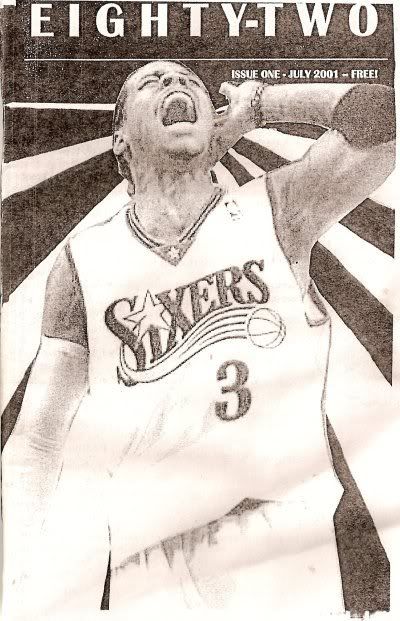
Always liked those action line thingys radiating out from behind his head.
There were ten articles. None of them were very good, or even any good, to be honest. A lot of Iverson love. Some bold predictions & daydreams about the next season. Still, it was fun to put together. For the follow-up a season preview issue was decided on.
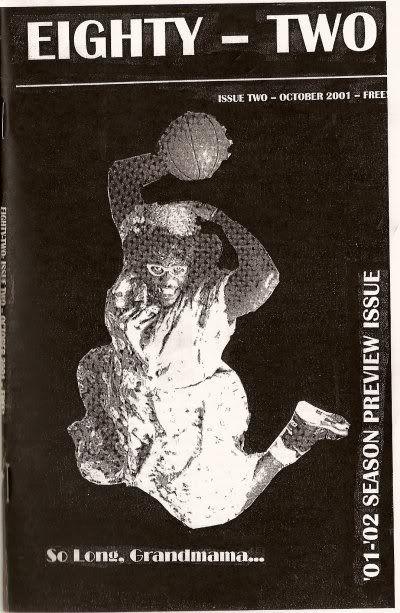
Larry Johnson quiety retired due to his bad back right before the start of the '01-'02 season, so he got the cover. The article count balloned to 22, although only 4 teams combined from the Midwest & Central Divisions (Dallas, Minnesota, Toronto, & Milwaukie) were previewed. Included in the 52 pages were ruminations on the return of zone defense, MJ in a Wizard's uniform, & a rather surreal article by yours truly about Harold Miner most consisting of the google translation of a german bio on Miner, which yielded gems like the following:
"Baby Jordan" was its pointed name. But could not follow large Jordan, Instead it took itself at the first part of its pointed name an example.WOW! Check this out, too. Discussing Miner's fortunes after winning the slam dunk contest as a rookie.
The baby whistled on his talent, on his branch strength, on the cash. Harold Miner does not play no more. Simply so. The stupidest course - or the most intelligent? If the college star were dead today, that would notice nobody. Allegedly not even its own mother, Where it even is, Whom it admires at most. Basketball does not play it no more, Perhaps but it throws on any baskets in Brazil and enjoys its life.
With Steve Smith it should form one of the best Backcourts in the league, And lead the Heat again into the Playoffs!Moving along, some promises were made for a mid-season issue, & everyone went back to business as usual. I was playing Final Fantasy Tactics on the ol' Playstation at the time & printed out some hints & such from the 'nets. Having started to get quite good at assembling folded booklets, I made myself a Final Fantasy Tactics booklet thingy, and, for some bizarre yet prescient reason, slapped the words "Eighty-Two presents:" in the upper left corner of the cover.
From this nothing became, in the season 1993/1994 missed Miner of 15 plays because of a back Pulling and problems with the right knee. Therefore it could hardly improve, At the end of the season was oneself. The heat with a new club record of 42:20 victories nevertheless acheived the playoffs. Miner became not worse But the gossip over " baby Jordan " became more quietly, The prognoses darker.
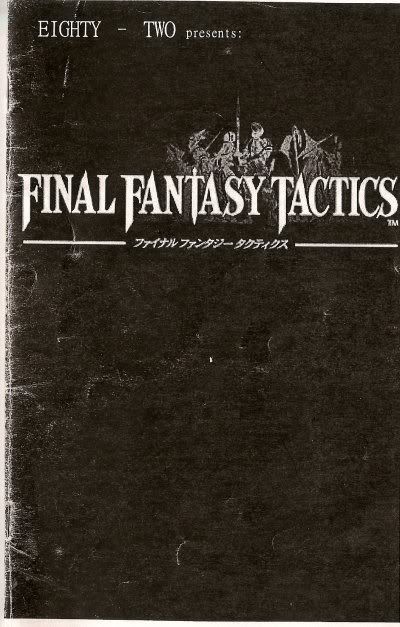
The FFT booklet was just 18 pages long. A walk-thru & some basic info on the various jobs of the game. But I think you might see where this is going. The portal had been crossed, & the world of the NBA invaded by stranger denizens. Issue 3 of Eighty-Two was thus the mammoth 46 page Codex:Xenogears issue, of which one copy exists, of which I have misplaced twice only to rediscover later. This is really was (and is) an encyclopedic resource for playing the Playstation RPG Xenogears. Perhaps the less said about this the better, tho' obviously I wasted many a lunch break putting it together.
I think by this time the actual reality of doing another collaborative NBA zine issue had collapsed due to boredom, laziness, & whatever unimportant reasons which seems important at the time. But I was still digging getting a hold of this formating of booklets thing, so Issue Four had the text from three William Gibson articles & an article about & an interview w/ Jim Thirlwell.
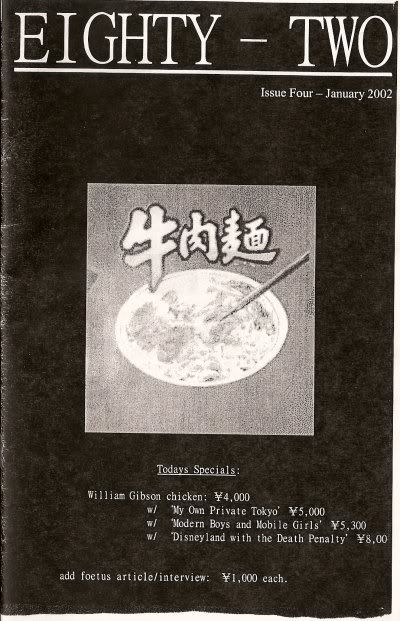
I like the "Today's Specials" menu motif on that cover.
Issue Five was probably the shittiest. Ultraman: A User's Guide. I was into kaiju stuff for a bit there. I tossed my online research into booklet form. 16 pages.
Issue Six in September of 2002 was better, & the last. Game hints for Frontmission3 & Legend of Mana. The text from David Foster Wallace's "f/x porn" article. Some filler in the form of additional Ultraman information. 56 pages.
Of course, the real breakthrough was that the title got changed to "Tinzeroes." As I wrote (to myself, I guess), in the Note from the Editor:
In a fit of egotistical rage, I, D.D. Tinzeroes, have commandeered the very name of this publication. What was formerly 'Eighty - Two' is from now on 'Tinzeroes.'
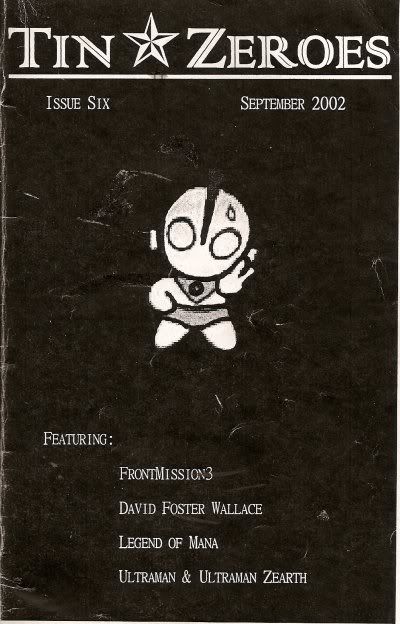
So there you have the pre-Reviewieran symbiosis of NBA & other stuff that I like: namely cyberpunk fiction, video games, Japanese cinema, & the music of JG Thirlwell.
-d.d.
1 Glancing through year-by-year standings & draft order, I was very quickly struck by how often, by sheer eternal shittiness, the Clippers were always at the top in terms of lottery balls, yet for the life of them could not draw a fucking No. 1 pick overall. Ditto for the Vancouver Grizzlies, who had lottery ball position in '96 (Iverson) AND '97 (Duncan), as well as '99 (Brand). The Grizzlies consolation prizes were Shareef Abdur-Rahim, Antonio Daniels, & Steve Francis, who memorably forced a trade to Houston (in exchange for Othella Harrington, Antoine Carr, Brent Price, Michael Dickerson & a 1st round selection).
Wednesday, January 03, 2007
Covenant of Hype, Covenant of Game.
As mentioned previously, I procured another copy of David Halberstam's The Breaks of the Game. I cannot stress enough how much this book either shaped my views of the NBA and/or crystallized existing sentiments. Halberstam spent & documented the '79-'80 season with the Portland TrailBlazers. But as any headcase & erudite fan of the L knows, one season is always only a shard of a larger story. So, as a historical document, the book details the early years of the Trailblazers franchise, more specifically a detailed retelling of the assembly and subsequent disassembling of the '77 championship team. There are deep & frankly soul-showing profiles, sprinkled in bits and pieces throughout the narrative, of Jack Ramsey, Bill Walton, Maurice Lucas, Larry Steele and Kermit Washington. Shorter profiles abound. Anecdotal gems spill from the pages like water from a sprinkler.
I came away from the reading with two nuggets of enlightenment:
1. Bill Walton absolutely loved the game of basketball. Once you've read the saga of his foot, and you know where he came from, and how much he loved the game, and you think about the hyperbolic asshole (at times) on television today, well, I feel that's the result of a career cut short by injury, which, I think, pains Walton to this very day. Especially the way he can hound big men in general & Shaq in particular: in his soul of souls Walton wants to be on the court, not talking about what's going on out on it.
2. Although much has changed, the NBA is still very much the same as it was 30 years ago. It was and always will be a business. A sports-entertainment business. What really sticks out is the inside view of the hair-pulling and gnashing-of-teeth process that is negotiating a new contract. Man alive! If you have trouble with CBA and cap rules as is, then don't try to comprehend the confusion when egos and pride and wives and families and strange interpersonal loyalties come into play. When chatting about the 40 Year Old Virgin w/ Fat, once, he remarked (maybe something someone else said or wrote) that there's little more terrifying & uncomfortable on this earth than 2 adults trying to make eachother feel bad. Inner emotional workings of contract negotiations - pride, responsibility, loyalty, memory, fear - are just as bad.
There's a lot more to love. Take the following. Its the start of training camp in the fall of '79. The Blazers coaching staff is enjoying breakfast, and are playing a game created by Stuart Inman, the Blazers VP & personnel manager. Its called 'Players I Would Pay to See,' and is really just an excuse for these coaches and staff to daydream about great players. Speaketh Inman...
A similar incident occurred immediately after the Cousy segment, they profiled Maravich. There wasn't so much revisionism this time around as convenient ignorance. He was depicted as the ultimate showman, &, well, that's basically correct, but it fails to draw the more emotional conclusions that Breaks of the Game does. Maravich had been drafted by Atlanta in '70, who broke up a successful, virtually all-black team when they opted to draft Maravich out of LSU. NBA basketball was not doing well in New Orleans when the Jazz traded 2 1st round picks, 2 2nd round picks, 2 roster players & any chance of the Jazz ever being any good in New Orleans for Maravich, & then signed him to a long-term deal worth $700,000 a year, purportedly more than the rest of the team's salary put together.8
-d.d.
1 Halberstam, David. The Breaks of the Game. Ballantine, New York. 1981. 14th printing, 1992. p.73.
2 ibid, p. 74.
3 ibid.
4 ibid, p. 75-75.
5 Flynn Robinson. No, I do not know why his nickname was "electric eye."
6 Charlie Paulk.
7 O's NBA.com profile.
8 Of course, by today's standards paying one player half of yr total team salary isn't quite as heretical a concept.
9 Halberstam, p. 98-99.
I came away from the reading with two nuggets of enlightenment:
1. Bill Walton absolutely loved the game of basketball. Once you've read the saga of his foot, and you know where he came from, and how much he loved the game, and you think about the hyperbolic asshole (at times) on television today, well, I feel that's the result of a career cut short by injury, which, I think, pains Walton to this very day. Especially the way he can hound big men in general & Shaq in particular: in his soul of souls Walton wants to be on the court, not talking about what's going on out on it.
2. Although much has changed, the NBA is still very much the same as it was 30 years ago. It was and always will be a business. A sports-entertainment business. What really sticks out is the inside view of the hair-pulling and gnashing-of-teeth process that is negotiating a new contract. Man alive! If you have trouble with CBA and cap rules as is, then don't try to comprehend the confusion when egos and pride and wives and families and strange interpersonal loyalties come into play. When chatting about the 40 Year Old Virgin w/ Fat, once, he remarked (maybe something someone else said or wrote) that there's little more terrifying & uncomfortable on this earth than 2 adults trying to make eachother feel bad. Inner emotional workings of contract negotiations - pride, responsibility, loyalty, memory, fear - are just as bad.
There's a lot more to love. Take the following. Its the start of training camp in the fall of '79. The Blazers coaching staff is enjoying breakfast, and are playing a game created by Stuart Inman, the Blazers VP & personnel manager. Its called 'Players I Would Pay to See,' and is really just an excuse for these coaches and staff to daydream about great players. Speaketh Inman...
"Bill Russell," Inman began it. "I remember the first time I saw him play and he couldn't even sink a free throw and he was skinny too and I thought, turkey, turkey. Then there was a fast break, a sure basket and at the last second Russell had raced the length of the court and swooped down and blocked the shot. It wasn't just the block, it was the psychological destruction that went with it. I remember," Inman continued, "when the Celtics would play the Lakers in championship games and the Laker crowd would be noisy and they would come out, one by one, and slap hands, and then they would introduce Russell and he would come out, and stand apart, absolutely motionless, his face scornful, and the crowd noise would just stop. He didn't just indimidate other players, he demoralize the home crowd."1Morris Buckwalter, Blazers assistant coach.
"They tell the story, I'm sure it happened, of Oscar [Robertson] going for the basket, making a move, putting a head fake on his man, and then spinning for the basket. He gets by and scores and [ref] Earl Strom calls it walking. 'How can it be walking when you've never even seen that move before?' Oscar asks Earl."2Inman, again.
"I would pay to see Bill Walton. A great shot blocker, a great concept of the game, great intelligence and he brought a special tempo to the game, there was a rhythm to his game and it was always the right rhythm. Most of all," he paused, "his effect on his teammates. As long as he was there they all knew they would be in every game and they controlled their own egos. With him they always knew they could do it as a team."3Jack Ramsey chimes in regarding Walton.
"He was so competitive," Ramsey said. "The bigger the game, the better he played. Once we were playing Milwaukie and he had made a couple of bad plays, and I called time, and the other players came over to the bench and he just stood there under the basket shouting at himself. 'Just don't throw me the fucking ball. Just pass it to anyone else.' Great competitor."4Speaking of players of yore, ESPN's apprently been repackaging those old NBA videos w/ Dan Patrick narrating. Although not quite the NFL Films treatment many of the faithful have been hoping for, I guess its a step in the right direction. Not surprisingly, however, the final product indulges in bits of dramatic anachronism. 1st of, following a Magic Johnson segment, Bob Cousy is profiled as the 1st great NBA "showman," but kindly depicts him hanging them up after winning a fifth consecutive championship w/ the Celtics. As an admirer of Big O, I found this immediately suspect & rank of revisionism: Cousy became coach of the Robertson's Cincinnati Royals in '69-'70, & the then-41-year-old Cousy even suited for 7 games that year along side O. Then, in the summer of '70, the Royals traded Robertson to the Bucks for Flynn "Electric Eye" Robinson (7 seasons in on 7 teams in 2 leagues)5 & Charlie Paulk (3 pro seasons on 4 teams)6.
Many observers believed it was Cousy's jealousy of Robertson that led to the trade. The Big O had just broken many of Cousy's records and Cincinnati was suddenly too small for the both of them. "Whatever his reasons were," Robertson later said, "I think he was wrong and I'll never forget it."7Perhaps this doesn't exactly tarnish Cousy's legacy. If anything, it precursors Magic's unspectacular attempts at a comeback & coaching of the Lakers or Jordan's stint in Washington. But to ignore trading Robertson? Gimme a break.
A similar incident occurred immediately after the Cousy segment, they profiled Maravich. There wasn't so much revisionism this time around as convenient ignorance. He was depicted as the ultimate showman, &, well, that's basically correct, but it fails to draw the more emotional conclusions that Breaks of the Game does. Maravich had been drafted by Atlanta in '70, who broke up a successful, virtually all-black team when they opted to draft Maravich out of LSU. NBA basketball was not doing well in New Orleans when the Jazz traded 2 1st round picks, 2 2nd round picks, 2 roster players & any chance of the Jazz ever being any good in New Orleans for Maravich, & then signed him to a long-term deal worth $700,000 a year, purportedly more than the rest of the team's salary put together.8
There had been, not surprisingly, tensions between Maravich and many of his teammates throughout his career (there were similar salary discrepancies everywhere he went), since in order to justify that much money he had to handle and shoot the ball all the time. But fans, particularly fans new to the game, loved him, he was exciting and wonderful at the theater of basketball. Weak management, worried about finding fans, loved him in the early years because it could hype him. More than any other athlete in basketball he dramatized the conflict between pure sports as they have been and sports in the modern televised era. He always landed in situations where a nervous management was anxious to hype, not the quality of the game but a show, Pistol Pete, the flashy scorer with the fancy moves. He was been handsomely rewarded for his service, not merely in terms of salary but in publicity; there had been magazine covers to pose for and television commercials to shoot. But at the same time something happened that was terrible for a fine athlete. His essential covenant had always been with hype instead of with his teammates and the game. Every move - and there were many - to sell him and make him the show had pulled him that further from his teammates and the idea of basketball. Now, in his tenth year of the professional game, one of the two or three highest-paid players in the league, he had a reputation in some quarters of being a loser. Even those sympathetic to him did not really know if he could play team basketball. His career was almost over and no one really knew how good he was.9That last sentence always makes me want to cry. The Hawks made the playoffs the first 3 years Maravich was in Atlanta, & lost in the 1st round each time (to the Knicks in '71 & then consecutively to the Celtics in '72 & '73). The Jazz never made the playoffs and moved to Utah. Do you see the simple deception in the ESPN piece's depiction? In light of Halberstam's portrayal does it seem false? I arch eyebrow & protrude lower lip at you, ESPN!
-d.d.
1 Halberstam, David. The Breaks of the Game. Ballantine, New York. 1981. 14th printing, 1992. p.73.
2 ibid, p. 74.
3 ibid.
4 ibid, p. 75-75.
5 Flynn Robinson. No, I do not know why his nickname was "electric eye."
6 Charlie Paulk.
7 O's NBA.com profile.
8 Of course, by today's standards paying one player half of yr total team salary isn't quite as heretical a concept.
9 Halberstam, p. 98-99.
bought that an' never played it: against quiet desperation
Discontented with everyone, and discontented with myself, I realized my Dreamcast had accumulated much dust, disuse. I tossed down the last of the day's coffee and tore the lid off a half-gallon of diet, for buzz maintenance. Time for some play. State-of-the-art, turn-of-the-century play.
Due to ecstatic reviews, the immense power of branding, and my own intense affection for the films, I've managed to accumulate something like five Resident Evil games across three platforms. I have played zero Resident Evil games. I marshalled my resources, my sense of what's a sequel, what a remake, what a spinoff, and plumped for Code: Veronica.
An hour in, I was incredibly enthusiastic...and scared. Horror's a great genre for games--arguably even a better use of the medium than straight action--and this was adequately-done horror indeed. Scary, tense, compelling experience.
Two hours in, I was put off and alienated. The controls make simply walking around an empty room, a room wholly free of zombies, a colossal pain in the ass. Combine the difficulty of motion with the necessity of combat, and add zombies? My fear wasn't the fucking zombies, my fear was playing the game with the control scheme given.
Thought I should clear the palate with something brightly-colored and actiony. Maybe something with lots of button-mashing, maybe something with a polished control scheme... Lingered long over Zombie Revenge, then Space Channel 5, but settled for Marvel vs. Capcom 2. After all, I dropped nearly fifteen dollars on the title, tying it for third-largest Dreamcast expenditure--time to get my money's worth!
Wow. Big roster. Really big.
Man do I not know who any of these Capcom characters are. Or how to use them. This soundtrack is abysmal.
Wow. It's gonna be a while before I come back to this one single-player. Shoulda stuck with Soul Calibur.
Playing stuff I bought and never played, though, this is sorta fun. I should give Toy Commander another shot!
I will never beat Toy Commander. While I like it, kinda, I find it mind-flayingly hard. The controls are intensely sloppy (cocksucking analog stick), and that's a recipe for infinite frustration. It's pretty, though, and the sense of being toy-sized in big house is thoroughly enjoyable. Some missions are vague enough to let me just dick around and sightsee, but this'll pall soon, because there's no way I'm getting good enough at this mess to unlock much of the terrain...
By this time, I clearly needed a little infusion of successful play. Having a shit-thumbed night, though, so where I'm going to find that? Put in another couple hours of Evolution 2, an underrated little JRPG out of St!ng, who gave my beloved pink handheld the wonderful Riviera and the brittle, flinty, remote Yggdra Union. No matter how off I may be, I can wrestle through a turn-based, menu-driven combat system any time. Managed to advance the (fairly thin) plot a little, and snoozed through a boss battle I'd over-leveled for (not my fault: got lost in the dungeon). Right around here I noticed it was six in the damn' morning and opted for some sack time.
At least now I know my little 'Cast isn't lonesome. Next week maybe I can visit Ryo and Ulala for a few hours. I miss those guys.
Due to ecstatic reviews, the immense power of branding, and my own intense affection for the films, I've managed to accumulate something like five Resident Evil games across three platforms. I have played zero Resident Evil games. I marshalled my resources, my sense of what's a sequel, what a remake, what a spinoff, and plumped for Code: Veronica.
An hour in, I was incredibly enthusiastic...and scared. Horror's a great genre for games--arguably even a better use of the medium than straight action--and this was adequately-done horror indeed. Scary, tense, compelling experience.
Two hours in, I was put off and alienated. The controls make simply walking around an empty room, a room wholly free of zombies, a colossal pain in the ass. Combine the difficulty of motion with the necessity of combat, and add zombies? My fear wasn't the fucking zombies, my fear was playing the game with the control scheme given.
Thought I should clear the palate with something brightly-colored and actiony. Maybe something with lots of button-mashing, maybe something with a polished control scheme... Lingered long over Zombie Revenge, then Space Channel 5, but settled for Marvel vs. Capcom 2. After all, I dropped nearly fifteen dollars on the title, tying it for third-largest Dreamcast expenditure--time to get my money's worth!
Wow. Big roster. Really big.
Man do I not know who any of these Capcom characters are. Or how to use them. This soundtrack is abysmal.
Wow. It's gonna be a while before I come back to this one single-player. Shoulda stuck with Soul Calibur.
Playing stuff I bought and never played, though, this is sorta fun. I should give Toy Commander another shot!
I will never beat Toy Commander. While I like it, kinda, I find it mind-flayingly hard. The controls are intensely sloppy (cocksucking analog stick), and that's a recipe for infinite frustration. It's pretty, though, and the sense of being toy-sized in big house is thoroughly enjoyable. Some missions are vague enough to let me just dick around and sightsee, but this'll pall soon, because there's no way I'm getting good enough at this mess to unlock much of the terrain...
By this time, I clearly needed a little infusion of successful play. Having a shit-thumbed night, though, so where I'm going to find that? Put in another couple hours of Evolution 2, an underrated little JRPG out of St!ng, who gave my beloved pink handheld the wonderful Riviera and the brittle, flinty, remote Yggdra Union. No matter how off I may be, I can wrestle through a turn-based, menu-driven combat system any time. Managed to advance the (fairly thin) plot a little, and snoozed through a boss battle I'd over-leveled for (not my fault: got lost in the dungeon). Right around here I noticed it was six in the damn' morning and opted for some sack time.
At least now I know my little 'Cast isn't lonesome. Next week maybe I can visit Ryo and Ulala for a few hours. I miss those guys.
Tuesday, December 05, 2006
Super Robot Wars Alpha.
Fat's in Seattle & called me to inform me he just dropped $100 on the Japanese import of Super Robot Wars Alpha for the Dreamcast (& the boot disk to trick his DC into thinkin' its Japanese). This is the version w/ mecha from 10 of the Gundam series &/or movies, Evangelion, Mazinger, Getter Robo, & Macross. WOW!!
I immediately started looking for screen shots & was FLOORED by the youtube snippets I found. The opening sequence, for example...
From Macross, the attacks of Roy Focker's veritech variable fighter! Yay!
The real gem. Eva units 00, 01, & 02. Check out how music, voicework, & actual cell animation from the series is worked into the game animation. Even a special joint attack derived from my fav episode: Both of You, Dance Like You Want to Win!
-d.d.
I immediately started looking for screen shots & was FLOORED by the youtube snippets I found. The opening sequence, for example...
From Macross, the attacks of Roy Focker's veritech variable fighter! Yay!
The real gem. Eva units 00, 01, & 02. Check out how music, voicework, & actual cell animation from the series is worked into the game animation. Even a special joint attack derived from my fav episode: Both of You, Dance Like You Want to Win!
-d.d.
Wednesday, November 29, 2006
Plastic Forms of Evangelion.
Stikfas is moving into the licensed figure arena. Of especial note: Neon Genesis Evangelion figures!!
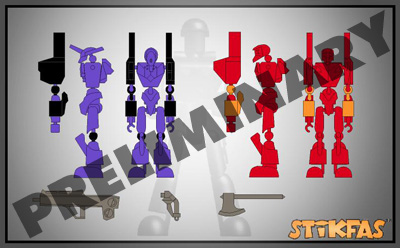
I've seen the Evangelion series twice, 1st on loaned VHS tapes1, 2nd on my own set of DVDs. I sincerely doubt I will ever watch it again. By contrast I watch an occasional Patlabor episode or three quite regularly. I'm not dissing Eva but its not like you can just que up a random episode & enjoy.
-d.d.
1 Said VHS tapes were on loan from a compatriot who in turn had the tape on loan from someone else. If I recall, said person also was fond, back in the day, of buying japanimation VHS cassettes from Suncoast Video at the mall, copying them, putting the copy in the original box, re-shrinkwrapping it & then returning it & start the whole process over again w/ another, new tape (this is when a copy of Akira ran you $30). I envision some bookshelf in the 'burbs filled w/ anime tapes w/o boxes.
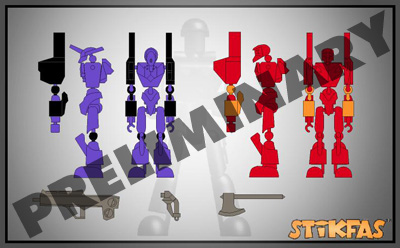
I've seen the Evangelion series twice, 1st on loaned VHS tapes1, 2nd on my own set of DVDs. I sincerely doubt I will ever watch it again. By contrast I watch an occasional Patlabor episode or three quite regularly. I'm not dissing Eva but its not like you can just que up a random episode & enjoy.
-d.d.
1 Said VHS tapes were on loan from a compatriot who in turn had the tape on loan from someone else. If I recall, said person also was fond, back in the day, of buying japanimation VHS cassettes from Suncoast Video at the mall, copying them, putting the copy in the original box, re-shrinkwrapping it & then returning it & start the whole process over again w/ another, new tape (this is when a copy of Akira ran you $30). I envision some bookshelf in the 'burbs filled w/ anime tapes w/o boxes.
Wednesday, November 15, 2006
sounds of the city all around & the music, the new licks you found
Reviewiera pulled 1 of its drunken state-of-the-NBA ad hoc committee sessions the other nite. Between eating a plate of nachos I really didn't need to ingest, & Fat consistently getting his Beam overpoured, the results were typically microcosmic & longue duree. Muse willing, Fat will be submitting the thesis he came away w/ from the evening's discourse, but my kernal of psuedo-wisdom concerned an overarching seismic shift in the League & its fandom.

The launchpad was my earlier revelation correlating the adulation of Rasheed Wallace by many Portland fans to Portland's "Little Beirut" identity tag in the late '90s & early aughties1. This realization is truthfully as close as I've ever come to actually positing a tangible correlation between a sports franchise & its fanbase in terms of a city's self-identity, a supposition usually easily proved bunk2. Fat brought up the point that starting in, say, '99 or '00, there were alot of NBA fans who basically focused thier energies around certain individual players, w/ little concern for the teams or indeed the course & saga of the season & the L as a whole. Two of those players were definitely Rasheed Wallace & Allen Iverson, both of which produced defining streches of thier careers in that period3. Chatting about the Rasheed-Little Beirut thing, & then the Rasheed-Iverson idolization years, I suddenly gleened a potentially macro-cosmic arch.
(1) Rabid homerism was essentially killed in the '90s when the Jordan Bulls won 6 championships in 8 years. Isn't there a statistic out there that something like 60% of Americans called themselves Bulls' fans in '98, or something along those lines? W/ the Bulls so dominant, I beleive that casual fans became apathetic to the plight & drudgery of thier local teams.
(2) In the post-Jordan hangover we were subjected to a bunch of Spurs & Lakers championships for 5 years, while the east was pathetically weak. Essentially, pulling for the local team remained a rather dire & depressing option. The better option, then, was to identify a handful of individual players (or, indeed, a player or two on almost every team) which you simply "liked," for whatever reason. When the Playoffs rolled around, you could peruse the bracket & say "I hope teams X, Y, & Z advance, because I like so-&-so on X," & so forth. You had little expectation of any of those teams actually achieving anything in terms of a run, since we all knew that every team was essentially a sacrificial offering to the Lakers or Spurs.
(3) Which brings us into the present-day, notably, the "trend" that kicked off in '04-'05, the year of Sonics & Suns, the class of '04. On opening night this year, Charles Barkley opined that "there are no more doormats in the NBA," & I, for one, agree w/ him. The past futility of following the local franchise hasn't so much ended, as perhaps every franchise may simply be more resplendent than they once were. Its okay to like bad teams again, because we have learned to appreciate them in different ways.4
Verily, the Empire is Fallen, Long Live the Provinces!!
-d.d.
1 Can Anyone Tell Me, Who is the Grand Poobah 'Round Here?
2 Especially w/ the frequency of free agent movement & trades in modern sports - its increasingly rare for a particular player, much less 12 of them, to come to "represent" thier team's city symbolically. If anything, fandom oft is little more than allegiance to a certain color scheme on a uniform. However, I'm not sure you can leave it at that, either. A sports franchise's uniform can easily be conceived of as city's flag or coat-of-arms in terms of a city's outward representation of itself to the rest of the nation. Portland fans always have & always will hate the Lakers, & honestly this might be more of a reflection of opinion about Los Angeles than about basketball. Similar currents used to be detected regarding the Jazz. By contrast no one seems to have a problem with Sacramento or Golden State.
3 In Wallace's case, playing his part in the Dunleavy Blazers reaching the Western Conf. Finals in '99 & '00, and then setting that record for techs. All the while some analysts were going so far as to call him the best PF in the L overall , in a time when the West was the Conference of the Power Forwards (Webber, Duncan, McDyess, Abdur-Rahim, Garnett). I have this distinct of memory of someone wearing a Rasheed Wallace t-shirt that featured a huge air-brushed print of 'Sheed, semi-comic book , semi-characteriture style, on the back. It was striking since it had been clearly created by someone w/ some semblance of artistic skill, produced, & sold - presumably in quantities large enough to justify the exercise. Iverson, of course, had that phenomenal lighting strike of a year in 2001, winning MVP & taking the 76ers to the Finals.
4 This point is more Fat's than mine, but this New Love owes huge tips of the hat to Simmons & Free Darko. Although neither really told me anything new, per se, both were intrumental in articulating ways of thinking about, & thusly positing different ways of watching, basketball. They have illustrated to us that its okay to love basketball, because it tells us something about ourselves, & its not completely retarded to assert that an interest in the travails of, say, Carmelo Anthony, somehow asserts something about oneself as a person. Say what you will about Simmons, but can you really deny that the dude's seeded a more vested, deeper love of the L in fans, & especially new fans, in the last five years? FreeDarko does the same, albeit at a more extrapolated level.

The launchpad was my earlier revelation correlating the adulation of Rasheed Wallace by many Portland fans to Portland's "Little Beirut" identity tag in the late '90s & early aughties1. This realization is truthfully as close as I've ever come to actually positing a tangible correlation between a sports franchise & its fanbase in terms of a city's self-identity, a supposition usually easily proved bunk2. Fat brought up the point that starting in, say, '99 or '00, there were alot of NBA fans who basically focused thier energies around certain individual players, w/ little concern for the teams or indeed the course & saga of the season & the L as a whole. Two of those players were definitely Rasheed Wallace & Allen Iverson, both of which produced defining streches of thier careers in that period3. Chatting about the Rasheed-Little Beirut thing, & then the Rasheed-Iverson idolization years, I suddenly gleened a potentially macro-cosmic arch.
(1) Rabid homerism was essentially killed in the '90s when the Jordan Bulls won 6 championships in 8 years. Isn't there a statistic out there that something like 60% of Americans called themselves Bulls' fans in '98, or something along those lines? W/ the Bulls so dominant, I beleive that casual fans became apathetic to the plight & drudgery of thier local teams.
(2) In the post-Jordan hangover we were subjected to a bunch of Spurs & Lakers championships for 5 years, while the east was pathetically weak. Essentially, pulling for the local team remained a rather dire & depressing option. The better option, then, was to identify a handful of individual players (or, indeed, a player or two on almost every team) which you simply "liked," for whatever reason. When the Playoffs rolled around, you could peruse the bracket & say "I hope teams X, Y, & Z advance, because I like so-&-so on X," & so forth. You had little expectation of any of those teams actually achieving anything in terms of a run, since we all knew that every team was essentially a sacrificial offering to the Lakers or Spurs.

(3) Which brings us into the present-day, notably, the "trend" that kicked off in '04-'05, the year of Sonics & Suns, the class of '04. On opening night this year, Charles Barkley opined that "there are no more doormats in the NBA," & I, for one, agree w/ him. The past futility of following the local franchise hasn't so much ended, as perhaps every franchise may simply be more resplendent than they once were. Its okay to like bad teams again, because we have learned to appreciate them in different ways.4
Verily, the Empire is Fallen, Long Live the Provinces!!
-d.d.
1 Can Anyone Tell Me, Who is the Grand Poobah 'Round Here?
2 Especially w/ the frequency of free agent movement & trades in modern sports - its increasingly rare for a particular player, much less 12 of them, to come to "represent" thier team's city symbolically. If anything, fandom oft is little more than allegiance to a certain color scheme on a uniform. However, I'm not sure you can leave it at that, either. A sports franchise's uniform can easily be conceived of as city's flag or coat-of-arms in terms of a city's outward representation of itself to the rest of the nation. Portland fans always have & always will hate the Lakers, & honestly this might be more of a reflection of opinion about Los Angeles than about basketball. Similar currents used to be detected regarding the Jazz. By contrast no one seems to have a problem with Sacramento or Golden State.
3 In Wallace's case, playing his part in the Dunleavy Blazers reaching the Western Conf. Finals in '99 & '00, and then setting that record for techs. All the while some analysts were going so far as to call him the best PF in the L overall , in a time when the West was the Conference of the Power Forwards (Webber, Duncan, McDyess, Abdur-Rahim, Garnett). I have this distinct of memory of someone wearing a Rasheed Wallace t-shirt that featured a huge air-brushed print of 'Sheed, semi-comic book , semi-characteriture style, on the back. It was striking since it had been clearly created by someone w/ some semblance of artistic skill, produced, & sold - presumably in quantities large enough to justify the exercise. Iverson, of course, had that phenomenal lighting strike of a year in 2001, winning MVP & taking the 76ers to the Finals.
4 This point is more Fat's than mine, but this New Love owes huge tips of the hat to Simmons & Free Darko. Although neither really told me anything new, per se, both were intrumental in articulating ways of thinking about, & thusly positing different ways of watching, basketball. They have illustrated to us that its okay to love basketball, because it tells us something about ourselves, & its not completely retarded to assert that an interest in the travails of, say, Carmelo Anthony, somehow asserts something about oneself as a person. Say what you will about Simmons, but can you really deny that the dude's seeded a more vested, deeper love of the L in fans, & especially new fans, in the last five years? FreeDarko does the same, albeit at a more extrapolated level.
Friday, November 10, 2006
Clockwork Tides
We've been busy manning the pumps. I was vaguely aware the Reviewiera offices were on top of the old east-side frog pond, but we didn't know there was a mole-man-esque underground lake below the sub-basement.
Super Robot Taisen: Original Generation is done, & I did done save the entire planet. The thrwarting of an alien invasion via a massively enjoyable turn-based strategy game exclusively featuring giant mecha was mainly accomplished on a train-trip to San Francisco and back. Truthfully, I was stuck on one damn mission the entire trip down, then broke through & rolled through a fistful of missions, handing out mecha-sized servings of mashed potato ass-kicking.

Especially noteworthy is the final 3 or 4 missions, a stage-by-stage final all-out assault on the Balmarian artificial planet, the White Star. Praiseworthy, if only because, having slogged through & figured out real sticky missions (like the aforementioned Portland-to-San Francisco exercise in frustration), the final missions were at-once competitive & yet easy at the same time.1
The general knock against Taisen in the reviewing-field is that in Japan the franchise frequently features mechs from tv series such as Evangelion, Gundam, and Getter Robo. Taisen is a product of Banpresto, a subsidiary of almighty BANDAI, which in turns owns the rights to the extensive Gundam franchise, so obtaining the licensing rights to those comes as little surprise. Its perhaps a penchant of Japanese marketing that other companies seem to have little problem allowing thier products to be pitched against each other in a video game made by a third-party. Obtaining these licenses for an American release of a Taisen game proved difficlt, which is why Banpresto went w/ the Original Generation thing. Even though the mecha involved look holy-hell a lot like mecha from the Gundam franchise, it turns out every single one of them is an original creation by the Banpresto team - hence, no licensing required.
The real consequence of completing Taisen is I can move on to Pokemon: FireRed Version. This may just be the best strategy turn-based semi-RPG I've ever laid thumbs on.

I don't know where to start. From the "collect 'em all" element, to the good ol' fashioned leveling-up process, to the "I wonder what this pokemon looks like when it evolves?", to the color-coded world ("Vermillion City"), to the strange pride & puffing-out-of-the-chest I get from winning a badge from a gym leader. Good, great video game fun.
And, of course, the NBA is underway. I stick to my best-case/worst-case scenario for the TrailBlazers: at best, they're basically last year's New Orleans/Oklahoma City Hornets, right down to the ROY in Roy & being in the playoff race (mathamatically). Worst case scenario is a record like last years, maybe 5 more wins, although the product on the floor will be infinitely more pleasant to watch.
And Zach! He really is in great shape, & I'm enjoying a summer's worth of dumbasses who called for his departure, claiming the team could go nowhere w/ him, having to suddenly & abruptly go silent (dicks).

My favorite observation thus far, however, is that in a few games the patently bullshit preseason "what to look fors" which stated this team would miss "intangible" players Blake & Khrypha were put to rest. Both those players (esp. Blake) were touted last season as guys who-don't-fill-up-a-stat-sheet-but-do-a-lot-of-little-things-on-the-floor. Sorry but don't you usually only need ONE of those guys? And aren't they usually overshadowed by the true stars of the team? Straws of postivity, these were, grasped at by the media to throw the fandom a bone.
-d.d.
1 And there is nothing more rewarding that laying the smacketh down on a final boss. The classic example of this is the two times I've played Final Fantasy VIII. The first time I didn't truly grasp the game's strategic system, & as a result the final boss took a gargantuan 3 hours to beat (& probably 4 or 5 tries). The second time round I'd achieved a true understanding of the game's ins & outs. The final boss was defeated in a mere 30 minutes of blissful ass-kicking limit-break assaults. Now that I think about it, this may be a particular merit of Japanese RPGs in general - an almost zen-like understanding of the game is what you're supposed to achieve, & your reward will be the summary dispatch of your greatest adversaries. Miyamoto Musashi & shit like that.
Super Robot Taisen: Original Generation is done, & I did done save the entire planet. The thrwarting of an alien invasion via a massively enjoyable turn-based strategy game exclusively featuring giant mecha was mainly accomplished on a train-trip to San Francisco and back. Truthfully, I was stuck on one damn mission the entire trip down, then broke through & rolled through a fistful of missions, handing out mecha-sized servings of mashed potato ass-kicking.

Especially noteworthy is the final 3 or 4 missions, a stage-by-stage final all-out assault on the Balmarian artificial planet, the White Star. Praiseworthy, if only because, having slogged through & figured out real sticky missions (like the aforementioned Portland-to-San Francisco exercise in frustration), the final missions were at-once competitive & yet easy at the same time.1
The general knock against Taisen in the reviewing-field is that in Japan the franchise frequently features mechs from tv series such as Evangelion, Gundam, and Getter Robo. Taisen is a product of Banpresto, a subsidiary of almighty BANDAI, which in turns owns the rights to the extensive Gundam franchise, so obtaining the licensing rights to those comes as little surprise. Its perhaps a penchant of Japanese marketing that other companies seem to have little problem allowing thier products to be pitched against each other in a video game made by a third-party. Obtaining these licenses for an American release of a Taisen game proved difficlt, which is why Banpresto went w/ the Original Generation thing. Even though the mecha involved look holy-hell a lot like mecha from the Gundam franchise, it turns out every single one of them is an original creation by the Banpresto team - hence, no licensing required.
The real consequence of completing Taisen is I can move on to Pokemon: FireRed Version. This may just be the best strategy turn-based semi-RPG I've ever laid thumbs on.

I don't know where to start. From the "collect 'em all" element, to the good ol' fashioned leveling-up process, to the "I wonder what this pokemon looks like when it evolves?", to the color-coded world ("Vermillion City"), to the strange pride & puffing-out-of-the-chest I get from winning a badge from a gym leader. Good, great video game fun.
And, of course, the NBA is underway. I stick to my best-case/worst-case scenario for the TrailBlazers: at best, they're basically last year's New Orleans/Oklahoma City Hornets, right down to the ROY in Roy & being in the playoff race (mathamatically). Worst case scenario is a record like last years, maybe 5 more wins, although the product on the floor will be infinitely more pleasant to watch.
And Zach! He really is in great shape, & I'm enjoying a summer's worth of dumbasses who called for his departure, claiming the team could go nowhere w/ him, having to suddenly & abruptly go silent (dicks).

My favorite observation thus far, however, is that in a few games the patently bullshit preseason "what to look fors" which stated this team would miss "intangible" players Blake & Khrypha were put to rest. Both those players (esp. Blake) were touted last season as guys who-don't-fill-up-a-stat-sheet-but-do-a-lot-of-little-things-on-the-floor. Sorry but don't you usually only need ONE of those guys? And aren't they usually overshadowed by the true stars of the team? Straws of postivity, these were, grasped at by the media to throw the fandom a bone.
-d.d.
1 And there is nothing more rewarding that laying the smacketh down on a final boss. The classic example of this is the two times I've played Final Fantasy VIII. The first time I didn't truly grasp the game's strategic system, & as a result the final boss took a gargantuan 3 hours to beat (& probably 4 or 5 tries). The second time round I'd achieved a true understanding of the game's ins & outs. The final boss was defeated in a mere 30 minutes of blissful ass-kicking limit-break assaults. Now that I think about it, this may be a particular merit of Japanese RPGs in general - an almost zen-like understanding of the game is what you're supposed to achieve, & your reward will be the summary dispatch of your greatest adversaries. Miyamoto Musashi & shit like that.
Subscribe to:
Posts (Atom)